


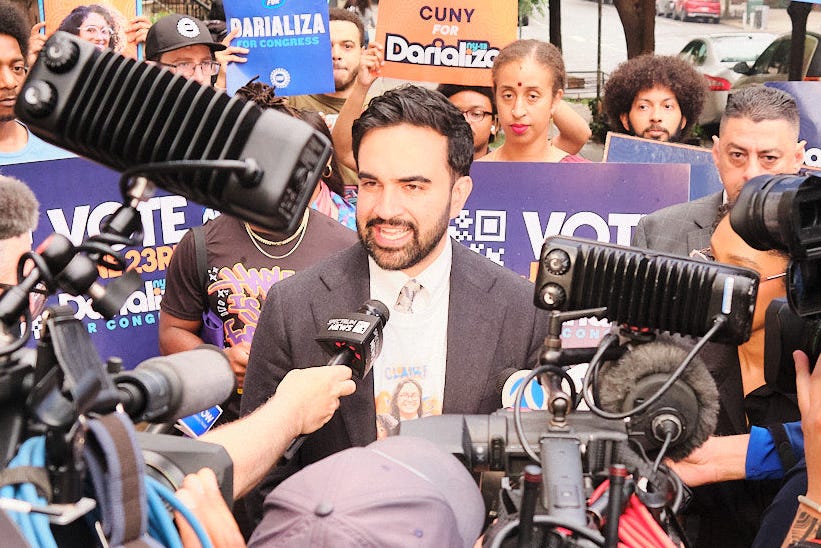
On Tuesday night, New York City Mayor Zohran Mamdani went a flawless 3-for-3.
All three congressional candidates he endorsed—Darializa Avila Chevalier, Brad Lander, and Claire Valdez—won their Democratic primaries. Two of them beat sitting members of Congress, establishment heavyweights. By January, Mamdani will have single-handedly reshaped the New York congressional delegation and sent two sitting incumbents packing. He accomplished all of this in his first year as mayor, operating in direct, open opposition to House Minority Leader Hakeem Jeffries—the most powerful Democrat in Washington.
This was not a safe political play. Darializa Avila Chevalier, in particular, was considered a total longshot by almost everyone; she was a first-time candidate with zero political experience taking on a five-term incumbent with a $9 million super PAC avalanche flooding the district to bury her. Mamdani chose her anyway.
He put his newly minted executive capital behind the entire slate, went to the mat for them, and completely swept the board.
Since his mayoral win, the gatekeepers of the Democratic establishment have gone to great lengths to downplay his meteoric rise. They treated his initial victory as a fluke—a temporary, anti-incumbent protest vote born of specific localized grievances rather than a genuine shift in the tectonic plates of the nation’s politics. Operating under the comfortable assumption that the progressive wave had already crested and rolled back, party leadership spent millions to assure donors the left was contained. On Capitol Hill, Jeffries openly minimized the threat, projecting an air of absolute certainty that a few loud primary challenges wouldn’t rewrite the DNA of the party.
But on Tuesday night, Mamdani didn’t just challenge that narrative. He completely obliterated it.
By executing a flawless cross-borough routing of the traditional party machine, Mamdani forced a stark, undeniable realization upon Washington: the old rules are officially dead, and the democratic socialist wave winning across the country is only getting stronger.
Consider the sheer scale of the wreckage.
In the 13th Congressional District, Darializa Avila Chevalier — a 32-year-old doctoral student and community organizer who was arrested after helping lead the Gaza war encampment protests at Columbia University — toppled five-term incumbent and Congressional Hispanic Caucus Chair Adriano Espaillat. Espaillat was viewed by party insiders as an absolute titan, completely insulated by deep institutional roots and backed by the full weight of the establishment.
When Mamdani endorsed her in May, what followed was a $9 million super PAC avalanche designed to bury her. They dug up old tweets. They ran mailers and TV ads across the Bronx and upper Manhattan highlighting a 2021 post in which she wrote “fuck Kamala Harris,” banking on the line to alienate Black voters in a district that is overwhelmingly Black and Latino.
It backfired, spectacularly. By running on an unapologetically working-class platform that confronted the party’s foreign policy consensus head-on, Avila Chevalier put one of the city’s most powerful machine bosses out of a job, proving that even a multi-million-dollar war chest cannot save a candidate completely disconnected from their base.
In the 10th District, former City Comptroller Brad Lander decisively defeated two-term multimillionaire incumbent Dan Goldman. Goldman, a darling of the moderate donor class championed by both Jeffries and Governor Kathy Hochul, found out the hard way that his brand of cautious, status-quo-protecting liberalism no longer satisfies an electorate grappling with a crushing affordability crisis and a profound moral reckoning over Gaza. Lander didn’t moderate his language to appeal to a mythical moderate majority; he leaned directly into the wind—promising to tax the rich, abolish ICE, and declare the war in Gaza a genocide—and walked away with a landslide. Remarkably, he pulled this off in New York’s 10th District, home to one of the largest Jewish electorates in the entire country.
To top off the evening, democratic socialist state Assembly Member Claire Valdez decisively claimed the seat of retiring Representative Nydia Velázquez in the 7th District. What makes Valdez’s victory so telling is that she didn’t just beat a moderate — she routed Brooklyn Borough President Antonio Reynoso, a man who held the combined endorsements of Velázquez herself, the Working Families Party, and the bulk of New York’s institutional progressive organizations. It turns out that when it comes to organizing power on the ground, the endorsement of Zohran Mamdani carries significantly more weight than the entire legacy progressive apparatus combined.
Predictably, the establishment will spend the coming days insisting that New York is merely a blue-bubble aberration. Jeffries actually said as much before the polls even closed, telling reporters that “a handful of primaries that go in one direction or the other... aren’t going to reshape who we are as House Democrats.”
He said this about an election in which his own handpicked candidates were utterly wiped out.
The problem with this framing is that leadership has been relying on it for a decade. They dismissed Bernie Sanders as a fluke, and then spent two consecutive presidential cycles actively tilting the levers of the party against him because they knew his message resonated. They called Alexandria Ocasio-Cortez a one-off. They insisted Mamdani couldn’t win New York City—and when he did, drawing over a million votes against a former governor backed by the entire party apparatus and the New York Times editorial board, they immediately pivoted to taking credit for his success. Now, they want us to believe Tuesday was meaningless.
“A year ago, they told us that our victory was the end of a political movement,” a smiling Mamdani told a chanting crowd of supporters on Tuesday night.
“But tonight proved it was just the beginning.”
It isn’t meaningless, and it certainly isn’t isolated to New York. What happened on Tuesday night is simply the most visible flowering of a national movement that has been quietly, methodically building for a generation.
Just last week, democratic socialist Janeese Lewis George won the Democratic primary for mayor of Washington, D.C.—bringing a progressive reformer to the nation’s capital despite aggressive threats of federal intervention from Donald Trump. Meanwhile, Nithya Raman is heading into a high-stakes mayoral runoff in Los Angeles. By the end of this year, there is a very real chance that three of the four largest cities in the United States will be led by socialist mayors.
This structural shift is expanding far beyond major urban centers. Across the country, candidates running on unapologetic, working-class platforms are systematically beating out the handpicked choices of the party leadership. In Minnesota, Lieutenant Governor Peggy Flanagan won her party’s Senate endorsement over a candidate quietly backed by Chuck Schumer and the DSCC. In Maine, outsider candidate Graham Platner secured a historic 72% of the vote for the U.S. Senate after surviving a coordinated establishment smear campaign.
The establishment desperately wants you to believe each of these victories is an isolated story — a quirky candidate winning a quirky district in a one-off result that proves nothing. But the math tells an entirely different story. This is a highly disciplined, organized national faction capable of taking on the full machinery of the Democratic leadership — and winning.
None of this means the institutional fight is over, or that the left has completely conquered the traditional apparatus. The establishment still controls massive resources, and they will continue to deploy them. What changed on Tuesday night is something far harder for corporate donors to combat: Mamdani proved that his endorsement has become the single most valuable currency in Democratic politics, carrying more weight than the house leadership and five terms in Congress.
The national party elite can try to take credit for these wins when it suits them, or they can double down on the status quo and pretend the old rules still hold.
Either way, the message from New York is clear.
The party of the past is over. The Party of Zohran has arrived.